

The Economy of an Independent Tatarstan
A conceptual article based on Ruslan Aysin’s report:
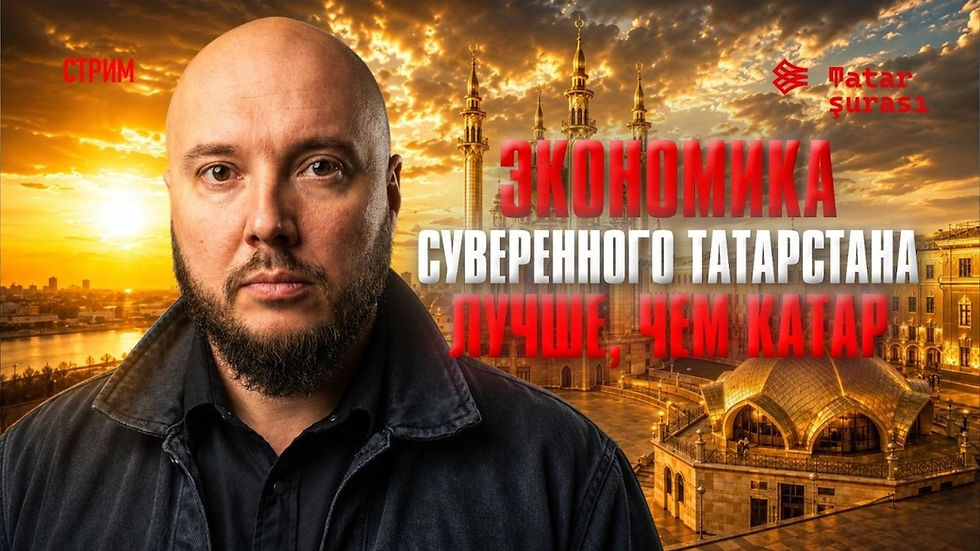
When we are told once again that Tatarstan will not “make it,” will “collapse,” and will “shut down” without Moscow, behind this there is always the same thing — an unwillingness to count. Once you sit down and calmly add up the numbers, the rhetoric of the metropolis falls apart. Economics is an exact science, and it knows neither Brezhnev’s slogans about “the economy must be economical” nor Putin’s patriotic blackmail. It knows only structure, flows, and balance. And it is precisely the structure of our republic’s economy that says that a sovereign Tatarstan is not simply viable — it is capable of becoming one of the most competitive economies in the entire Volga-Ural space.
Let us begin with the foundation. Tatarstan’s gross regional product already exceeds 5.5 trillion rubles today. This is not a raw-material monoculture, not a pure “oil pipe” — this is a balanced complex in which extraction exists alongside deep processing, and heavy industry alongside the middle class and the service sector. 30 million tons of oil per year, while 100% of local oil is processed in the republic. Proven reserves of conventional oil, according to estimates, will last for 30–40 years — that is a head start of two generations. And this is not counting 7 billion tons of natural bitumen, which we have already learned to bring into economic circulation. Nizhnekamskneftekhim and Kazanorgsintez produce more than half of polyethylene and about 40% of synthetic rubbers in the entire Idel-Ural region — here we are monopolists on a regional scale.
On top of this there is a high-tech belt: KAMAZ as a producer of heavy commercial vehicles, the Kazan Aircraft Plant and the Kazan Helicopter Plant, shipbuilding in Zelenodolsk, and all of this is completed by a surplus agro-industrial complex: Tatarstan is one of the all-Russian leaders in the production of milk, meat, and grain; in wheat we traditionally come second after Krasnodar. The republic provides its own food security, without handouts from Moscow, and also creates an export fund.
The main fiscal shock of sovereignty will not even be the introduction of new taxes, but the end of the old robbery. Today, around 70% of the taxes collected in Tatarstan go to Moscow — above all the mineral extraction tax on oil and VAT, which is taken from every added value. This is a slave tribute paid for unclear reasons: for war, for “Putin’s wishes,” for someone else’s imperial ambitions. At the moment when these flows are turned around and remain at home, the republic receives a huge surplus of capital. Not the deficit in which we are kept now, but precisely a surplus — more money than expenses. And the main task of an independent government is not to waste these trillions, but to direct them wisely: toward lowering the basic VAT rate and profit tax, subsidizing tariffs for domestic producers, and making electricity and logistics cheaper for KAMAZ and the petrochemical giants.
At the same time, a Tatar State Development Fund is created — following the model of the Norwegian sovereign fund, which today holds more than a trillion dollars. Excess oil revenues are directed not into the pocket of the imperial center, but into a diversified international portfolio, the profit from which already works for the citizens of Tatarstan. This is the cushion in case oil prices fall; this is the insurance for future generations. In the monetary sphere, a national currency is introduced — let us call it the altyn or the Tatar sum, the name is not the point — and during the transition stage it is rigidly tied to a basket of oil products and the gold and foreign currency reserves of the Tatar National Bank. No speculative fluctuations, no chaos — only the discipline of backing.
The main objection of skeptics is being landlocked. They say, where will you go, you are surrounded on all sides. But it is enough to look at the map to see the obvious: we have Idel, the Volga, and we have the historic Volga route “North–South,” which worked even in the times of Volga Bulgaria. Restoring its extraterritorial status is a political task, not a geographical one. Through the modernized ports of Kazan, Chistopol, and Naberezhnye Chelny, river-sea class ships go to the Caspian, and from there to the markets of Kazakhstan, Turkmenistan, Azerbaijan, and Iran. Further through Iran, the Indian Ocean opens up; through Turkmenistan and Kazakhstan, the Uzbek market of 35 million consumers opens up; through the Caspian, the Gulf countries open up. Yes, there is a seasonal limitation, the freezing of the northern section of Idel; this means that for these months excess storage capacity is built and a logistics reserve is formed. This is an engineering task, and it is solvable.
So that neighbors do not strangle us with customs duties, we come in with a trade advantage that Moscow does not have — our own logistics. Tatarstan signs free trade zone agreements with Bashkortostan, Kazakhstan, and other brotherly territories: they do not impose duties on our polymers and trucks, and in return they receive preferential access to our transport and port infrastructure. This is not charity, but a natural symmetrical exchange. And on this basis a trade portfolio is built: polyethylene and polypropylene for the tire industry of the CIS, KAMAZ trucks and electric buses, Mi and Ansat helicopters, Euro-6 diesel and aviation kerosene, and also — as a separate strategic cluster — certified halal products for Central Asia and the Middle East, where the food crisis is growing, and demand for high-quality meat and dairy goods exceeds supply.
Then the integration vertical begins to work: the Volga Economic Union is already a market of 10–12 million active consumers. The logic of the Tatarstan–Bashkortostan tandem is especially obvious: uniting the petrochemical capacities of Ufa, Salavat, Sterlitamak, and Nizhnekamsk, coordinating polymer prices, joint control over the synthetic rubber market, mutual exchange of scarce fractions such as ethylene and propylene. Chuvashia joins this with electrical engineering and relay manufacturing for Kazan aviation and automotive production, and Mari El with timber and cellulose. Once the gates are opened, people will begin trading themselves, without orders from above, because in Tatarstan the administrative burden has traditionally been heavier than among the neighbors, and business has long known where it is easier to breathe.
But the material economy is only half of the equation. The second half is what the imperial center will not be able to take away, no matter how much it wants to: the intangible asset. We have Innopolis, the only city in the Russian Federation built from scratch after the collapse of the USSR, and it was created literally for the role of an extraterritorial IT hub. We introduce a Tax Holiday regime — zero percent on profit, zero on dividends, zero on intellectual property for IT exporters — and invite developers to work. Turkey already offers investors zero, Singapore built its entire strategy on this; why can we not implement it? A cryptocurrency and AI “sandbox” with legal status, R&D centers from Asia, data centers on cheap energy — all of this fits organically onto the infrastructure that has already been built in Tatarstan and only needs political conditions in order to take off.
Islamic banking goes as a separate track — and here we have a starting advantage measured in centuries. The Tatars are the northernmost Muslim people; Islam was adopted in Volga Bulgaria as the state religion more than 1,100 years ago, in 922. This historical capital is enough to issue sukuk — Muslim bonds secured by real industrial assets, not by air. Through sukuk, sovereign funds from Saudi Arabia, Qatar, Turkey, and Malaysia enter Tatarstan. Infrastructure financing according to the principles of mudaraba and musharaka means sharing profits and risks with Gulf investors — this is partnership, not interest bondage, which is forbidden in Islam. Tatarstan, with its Kazan Halal Summit and regular economic forums, has already proven that the Muslim world perceives it as a natural entry point into the Volga region; all that remains is to remove the imperial shackles from this point.
Energy is a separate and honest conversation. Tatarstan has a surplus of motor fuel and petroleum products, but it is integrated into the unified Russian energy system and depends on Yamal gas: Tatneft’s own production of associated gas is around 0.9–1 billion cubic meters per year, while the republic’s consumption is 16–18 billion. There is a solution. It is important to approach this with a constructive strategy. First, long-term agreements with Yamal, Kazakhstan, and Turkmenistan based on mutual benefit: gas has to be supplied somewhere anyway, and the main pipeline goes through us. Second, modernization of the Minnibayevo Gas Processing Plant to 99% useful utilization of associated gas. Third, expansion of underground storage facilities — a strategic reserve for 6–9 months of operation of industry and housing and communal services, as is done today in Europe.
The electric power sector must be modernized without illusions. Zainskaya GRES should be converted to combined-cycle gas turbines, which will reduce specific gas consumption by one third. Nizhnekamsk Hydroelectric Power Plant should maximize the capacity of low-head turbines. TAIF, Tatneft, and KAMAZ will continue building their own block power stations, which relieves the general grid and protects factories from accidents. The networks are synchronized with Bashkir and Samara networks on a commercial basis — mutual insurance is more profitable than isolation. And on top of that comes the green transition: wind farms in the Kamsko-Ustyinsky, Spassky, and Rybno-Slobodsky districts with a potential of 150–200 megawatts, biogas stations at livestock complexes (Tatars from abroad had already come with ready technologies, but the former authorities simply did not allow them in), small hydropower on the richest water resources of Idel and Chulman, the Kama. At the widest point, the Volga and Kama spread out over 43 kilometers — it would be a sin not to use this resource.
But no petrochemistry, no Innopolis, and no sukuk will work without the main thing — without the quality of diplomacy. The success of a sovereign Tatarstan will depend almost one hundred percent on foreign policy: on flexible transit agreements, on personal work with investors, on agents of influence who will tell the world not Moscow’s version of us, but our own. And here the republic has a resource that cannot be counted by any accounting method: 25% of Tatars live in Tatarstan, 75% outside it, all over the world. Engineers, scientists, businessmen, cultural figures — once a call is made, this human capital will respond not out of calculation, but out of a feeling of homeland. This may be our main investment.
The conclusion is simple and serious at the same time. The economic model of an independent Tatarstan is viable; moreover, it has the potential to become a high-tech financial and industrial hub, a Volga Singapore or, for those who prefer the comparison, a Volga Malaysia. We have a surplus budget, developed petrochemistry, machine building, an agricultural surplus, Innopolis, Islamic capital, and the Volga. We have 1,100 years of state history and a multimillion diaspora. We have, as they say, everything — except one thing. Except political will, for now. But will is something that can be acquired, and it comes together with the understanding that independence is not a risk, but exactly the opposite — a refusal of the risk of slowly burning in someone else’s war. Tatarstan is capable of forging sovereignty for itself. This article is not a utopian description; it is quite literally a draft of an instruction manual.
